
Habit Tracker vs Goal Tracker: What's the Difference and Which One Should You Use?
Tenor
Tenor Editorial Team
A habit tracker and a goal tracker can look almost identical at first.
Both can show progress. Both can use calendars, checklists, numbers, reminders, and charts. Some productivity apps even combine habits and goals in the same dashboard.
But they answer two different questions.
A habit tracker asks:
Did I do the behavior?
A goal tracker asks:
Am I getting closer to the result?
That difference matters.
If your goal is to read 12 books this year, reading 20 pages today is a habit. Finishing 12 books is the goal.
If you want to run a marathon, following your running schedule is a habit. Completing the race is the goal.
If you want to save 6,000 is the goal.
The best system doesn't force you to choose between habits and goals. It helps you understand which layer you actually need to track.

Habit Tracker vs Goal Tracker: The Core Difference
The simplest way to understand the difference is to separate behavior from outcome.
| Habit tracker | Goal tracker |
|---|---|
| Tracks recurring behavior | Tracks progress toward an outcome |
| Usually repeats on a schedule | Usually has a target or endpoint |
| Asks "Did I do it?" | Asks "How far have I got?" |
| Useful for consistency | Useful for direction and progress |
| Example: Run 3× per week | Example: Run a 10K race |
| Example: Read 10 pages daily | Example: Read 20 books this year |
| Example: Save $500 monthly | Example: Save $6,000 |
Neither is inherently better.
They solve different problems.
Research on goal progress monitoring provides a useful reason to distinguish the two: a meta-analysis of 138 studies involving 19,951 participants found that interventions that increased progress monitoring also improved goal attainment, with larger effects when progress was physically recorded or reported.
The practical takeaway isn't that everyone needs a complicated tracking system.
It's that tracking the behavior and tracking the outcome can provide different information.
What Is a Habit Tracker?
A habit tracker records whether you repeatedly performed a specific behavior.
Examples include:
- Walk for 20 minutes
- Read 10 pages
- Meditate for 5 minutes
- Practice Spanish
- Go to the gym
- Journal
- Drink water
- Study for 30 minutes
- Stretch
- Go to bed before 11 p.m.
The behavior is usually something you can perform repeatedly.
A basic habit tracker might therefore look like:
| Habit | Mon | Tue | Wed | Thu | Fri |
|---|---|---|---|---|---|
| Read 10 pages | ✓ | ✓ | — | ✓ | ✓ |
| Walk 20 min | ✓ | — | ✓ | ✓ | ✓ |
| Study 30 min | — | ✓ | ✓ | ✓ | — |
The tracker isn't necessarily telling you whether you've achieved a major life outcome.
It's telling you whether you're showing up for the behavior.
That's useful when your main problem is consistency.

What Is a Goal Tracker?
A goal tracker focuses on an intended result.
Instead of asking whether you performed a repeated action, it measures movement toward a target.
Examples:
- Save $6,000
- Run a 10K
- Read 20 books
- Complete a certification
- Launch a website
- Reach a certain weight
- Finish a course
- Write a 50,000-word book
A goal tracker might look like:
| Goal | Starting point | Current | Target |
|---|---|---|---|
| Savings | $1,000 | $3,500 | $6,000 |
| Books read | 0 | 8 | 20 |
| Course progress | 0% | 65% | 100% |
The important difference is that the goal has an outcome to move toward.
A goal can contain many different behaviors.
For example:
Goal: Complete a professional certification.
Possible supporting habits:
- Study 30 minutes Monday–Friday
- Review flashcards
- Complete one practice test each week
- Watch one lesson
The habits support the goal.
The goal gives those habits a destination.
Habit vs Goal: A Simple Example
Imagine you want to become a regular runner.
Your goal might be:
Run a 10K race by November.
Your habits might be:
Run three times per week.
Strength train twice per week.
Stretch after each run.
Your goal tells you where you're going.
Your habits tell you what you repeatedly do.
This distinction becomes especially useful when a habit is going well but the desired outcome isn't.
You could have:
60 consecutive running days
and still discover that your training isn't moving you toward your actual race target.
The opposite can also happen.
You might be moving toward a goal but struggling with consistency because your daily system is poorly defined.
That is why the two types of tracking can complement each other.
When Should You Use a Habit Tracker?
A habit tracker is usually the better choice when your main problem is:
"I know what I need to do, but I don't do it consistently."
For example:
You want to read more
Track:
Read 10 pages.
Not:
Become a reader.
You want to exercise regularly
Track:
Complete planned workout.
Not:
Become fit.
You want to practice a language
Track:
Practice Spanish for 15 minutes.
Not:
Become fluent.
You want to sleep earlier
Track:
Be in bed by 11 p.m.
Not:
Improve my sleep.
The closer the tracker is to an action you can actually perform, the more useful the check-in becomes.
When Should You Use a Goal Tracker?
A goal tracker becomes more useful when your main problem is:
"I have a result I want to achieve, but I need to know whether I'm actually making progress."
For example:
Saving money
A monthly savings habit:
Transfer $500.
A goal:
Reach $6,000 in savings.
Reading
A daily habit:
Read 10 pages.
A goal:
Read 20 books this year.
Learning
A recurring habit:
Study 30 minutes each weekday.
A goal:
Pass the certification exam by December.
Fitness
A recurring habit:
Run three times per week.
A goal:
Complete a 10K race.
The goal tracker gives you the larger picture.
Can a Habit Be a Goal?
This is where the terminology gets confusing.
People often say things like:
"My goal is to exercise every day."
Technically, that's describing a behavior target rather than an outcome.
There's nothing inherently wrong with calling it a goal in everyday language.
But when you're designing a tracking system, the distinction is useful.
Compare:
Behavior
Exercise 4 times per week.
Outcome
Complete a 10K race.
The first is something you repeatedly do.
The second is something you're trying to accomplish.
This distinction helps you decide what belongs in a habit tracker and what belongs in a goal tracker.
Should You Track Habits or Goals?
In many cases, both.
But don't automatically track everything.
Start with the layer that corresponds to your actual problem.
If consistency is your problem
Use a habit tracker.
Your question is:
"Am I doing the behavior?"
If direction is your problem
Use a goal tracker.
Your question is:
"Am I getting closer to the result?"
If both are problems
Connect them.
For example:
Goal: Save $6,000 by December.
Habit: Transfer $500 every month.
Now the habit has context, while the goal has an actionable behavior attached to it.

How to Connect Habits to Goals
The most useful system is often a simple hierarchy:
Goal → recurring habits → individual actions
For example:
Goal
Run a 10K by November.
Supporting habits
- Run 3× per week
- Strength train 2× per week
- Stretch after runs
Individual action
Today's 5 km run.
Each layer answers a different question.
Goal: Where am I going?
Habit: What do I repeatedly do?
Action: What do I do today?
This structure also helps prevent a common problem: tracking habits that aren't connected to anything you actually care about.
A list containing:
- Drink water
- Meditate
- Read
- Exercise
- Journal
may look healthy and productive.
But if none of those behaviors connects to your current priorities, the tracker can become a collection of checkboxes rather than a useful system.
Use Goals to Choose the Right Habits
Instead of starting with:
"What habits should I track?"
Start with:
"What am I trying to accomplish?"
Then work backward.
Goal: Read 20 books this year
Possible habits:
- Read 10 pages each day
- Read for 20 minutes before bed
- Keep your phone away while reading
Goal: Pass an exam
Possible habits:
- Study 45 minutes on weekdays
- Review flashcards
- Complete one practice test each weekend
Goal: Save $6,000
Possible habits:
- Transfer $500 monthly
- Review spending every Sunday
- Avoid one unnecessary purchase category
Goal: Improve fitness
Possible habits:
- Exercise three times per week
- Walk regularly
- Prepare workouts in advance
The goal filters the list.
You don't need every "good habit."
You need the habits that support your current objective.
Don't Turn Every Goal Into a Habit
The opposite mistake is also common.
Once people discover habit tracking, they sometimes try to turn every goal into a recurring checkbox.
That doesn't always work.
Consider:
Launch my website.
That's a goal.
It contains multiple tasks:
- Choose a domain
- Design pages
- Write content
- Configure hosting
- Test forms
- Publish
You wouldn't necessarily want:
"Work on website"
as a permanent habit.
A task list, project tracker, or milestone system may be better for that kind of work.
A useful rule is:
If the behavior repeats, consider a habit. If the work moves through distinct stages toward an endpoint, consider a goal or project.
Habit Tracker vs Goal Tracker vs To-Do List
These three tools are often mixed together, but they have different jobs.
| Tool | Main question | Best for |
|---|---|---|
| Habit tracker | Did I repeat the behavior? | Routines |
| Goal tracker | Am I progressing toward the target? | Outcomes |
| To-do list | What needs to get done? | Tasks |
Consider launching a blog.
Goal
Publish 20 high-quality articles this quarter.
Habits
Research for 30 minutes each weekday.
Write for 45 minutes each morning.
Tasks
Research keyword for Article 12.
Draft introduction.
Create meta description.
Upload article.
The same project can therefore use all three systems without them being redundant.
For Tenor readers who want a deeper comparison between recurring behaviors and task lists, the existing habit tracker vs. to-do list guide is a natural next read.
Habit Tracker vs Goal Tracker vs Journal
A journal adds another layer.
A journal answers questions such as:
What happened?
How did I feel?
What did I learn?
Why did something work or fail?
A habit tracker is structured.
A goal tracker is outcome-oriented.
A journal is reflective.
For example:
Goal
Improve focus.
Habit
One 45-minute distraction-free work session.
Journal
"I focused better today because I left my phone in another room."
Now you have:
Direction → behavior → context.
This can be more useful than forcing one tool to do everything.
Do You Need a Separate Goal Tracker?
Not necessarily.
If you only have a few goals, you can keep the goal layer simple.
For example, a notebook or spreadsheet could contain:
Goal: Read 20 books.
Current: 7.
Target: 20.
Deadline: December 31.
Then your habit tracker handles:
Read 10 pages.
You don't necessarily need a dedicated application for every layer.
The right system is the simplest one that gives you the information you actually need.
How Often Should You Track Goals?
Unlike habits, goals don't always need daily updates.
The appropriate frequency depends on what you're measuring.
Daily
Useful when progress changes frequently.
Examples:
- Daily word count
- Daily study time
- Daily spending
Weekly
Useful for reviewing broader progress.
Examples:
- Weekly running distance
- Weekly project milestones
- Weekly savings
Monthly
Useful for larger outcomes.
Examples:
- Monthly savings
- Books completed
- Course progress
The important distinction is that tracking frequency should match the thing being measured.
You don't need to stare at a long-term goal every day if the underlying number barely changes.
Use a Habit Tracker for Inputs and a Goal Tracker for Outcomes
One of the cleanest ways to combine the two is to think in terms of:
Inputs → process → outcome
For example:
Fitness
Input: Train three times per week.
Process: Follow your running plan.
Outcome: Complete a 10K.
Learning
Input: Study 30 minutes per day.
Process: Complete lessons and practice questions.
Outcome: Pass the exam.
Savings
Input: Transfer $500 each month.
Process: Follow your spending plan.
Outcome: Reach $6,000.
The habit tracker is strongest at the input/process level.
The goal tracker is strongest at the outcome level.
This separation makes your system easier to understand.
What If Your Habit Is Going Well but Your Goal Isn't?
This is one of the most useful reasons to track both.
Suppose you've completed:
90% of your planned study sessions.
But your practice-test scores haven't improved.
That's valuable information.
The problem may not be consistency.
It may be:
- The study method
- The material
- The difficulty
- The amount of practice
- The type of feedback you're getting
The habit tracker tells you:
I am doing the behavior.
The goal tracker tells you:
The behavior isn't producing the desired progress yet.
That doesn't automatically mean the habit is useless.
It means you have another variable to investigate.
What If Your Goal Is Moving but Your Habits Are Inconsistent?
The opposite situation can happen too.
Maybe you're making progress toward your goal even though your routine looks messy.
In that case, you might not need more tracking.
You might simply need to identify which behaviors are actually contributing to the progress and make those easier to repeat.
This is why tracking should serve decision-making.
More data isn't automatically better.
A Simple System You Can Start Today
You don't need a complicated productivity dashboard.
Try this three-layer setup.
1. Choose one goal
Write:
What result am I trying to achieve?
Example:
Pass my certification exam by December.
2. Choose two or three supporting habits
For example:
Study 30 minutes Monday–Friday.
Complete one practice test each week.
Review flashcards for 10 minutes.
3. Review the goal periodically
Ask:
Am I making progress?
Are these habits actually helping?
What should change?
This creates a feedback loop:
Goal → habits → tracking → review → adjustment.
Progress monitoring is not merely about collecting checkmarks; research suggests that monitoring can help translate goals into action, particularly when progress is recorded.

Make Your Habits Specific
One final distinction matters.
A goal can be broad:
Become healthier.
But the supporting habit should be specific:
Walk for 20 minutes after lunch.
A goal can be:
Improve my writing.
The habit could be:
Write 300 words each weekday.
A goal can be:
Save more money.
The habit could be:
Transfer $500 on payday.
Specific actions are easier to schedule and evaluate.
Implementation-intention research also supports the value of specifying the when, where, and how of goal-directed behavior. A 2006 meta-analysis covering 94 independent tests found that these "if–then" plans improved goal attainment.
So instead of:
"I'll study more."
Try:
"After dinner on weekdays, I'll study for 30 minutes at my desk."
The goal gives you direction.
The plan tells you how to act.
The Best Choice Depends on the Problem
There isn't a universal winner in the habit tracker vs goal tracker debate.
Use a habit tracker when you need to repeat a behavior.
Use a goal tracker when you need to measure progress toward an outcome.
Use a to-do list when you need to manage individual tasks.
Use a journal when you need to reflect and understand what is happening.
And when your goal depends on repeated behavior, combine the layers.
A simple system might be:
Goal: Read 20 books this year.
Habit: Read 10 pages every day.
Action: Read 10 pages tonight.
That is enough structure to connect what you want with what you actually do.
The goal tells you where you're going.
The habit tells you what you repeat.
The task tells you what happens next.

The Bottom Line
A habit tracker and a goal tracker aren't competing versions of the same tool.
They operate at different levels.
Goals tell you what you want to achieve.
Habits tell you what you repeatedly do.
Tasks tell you what needs to happen next.
If you're building a system for personal progress, start with the result you care about, identify the behaviors that support it, and track each layer according to what it actually needs to measure.
You don't need more checkboxes.
You need the right checkbox for the right job.
Track Habits and Goals with Tenor
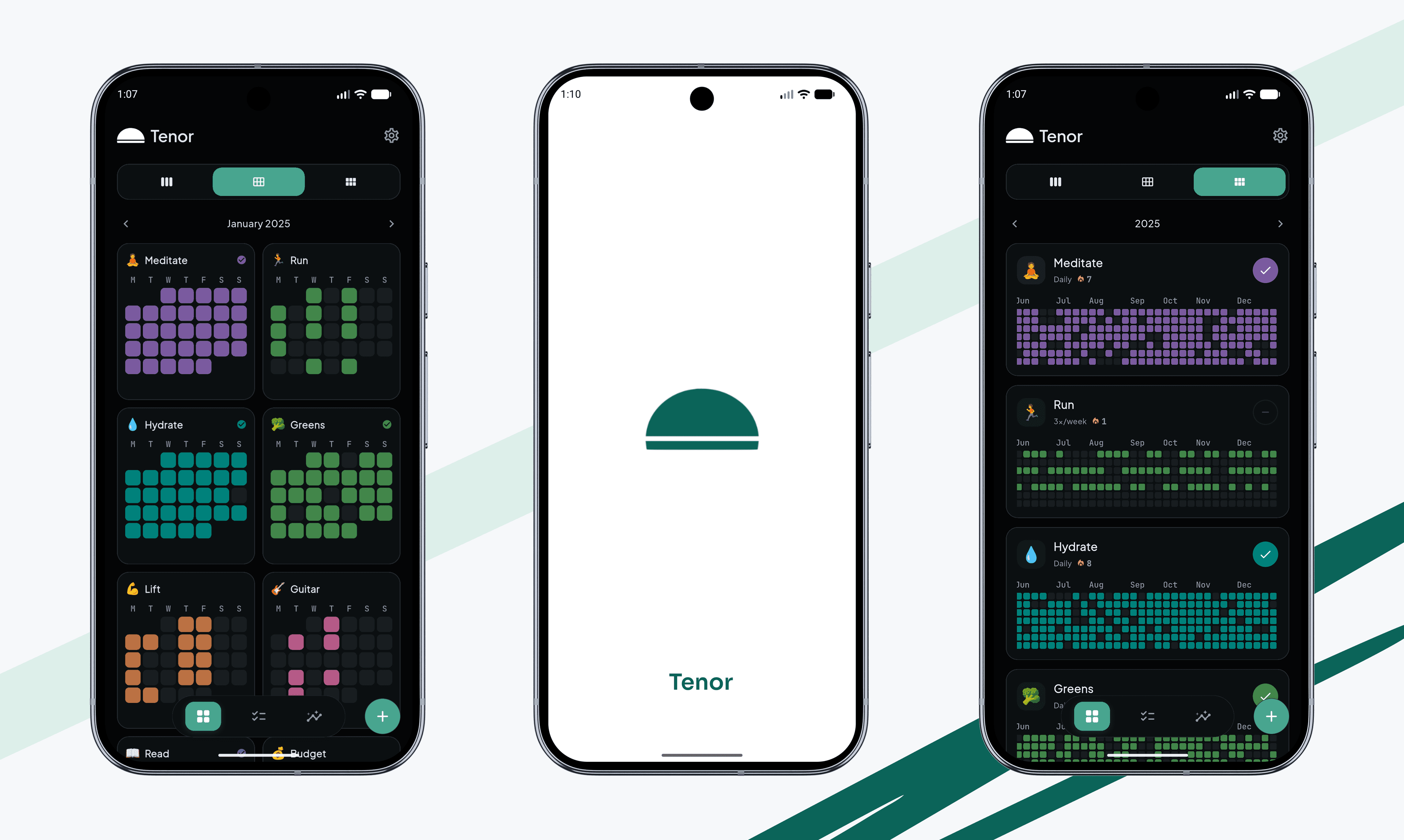
If you want a simple way to keep recurring behaviors separate from everyday tasks, a dedicated habit tracker such as Tenor can give those behaviors their own focused space.
- Track daily habits with simple check-ins
- See your consistency over time
- Keep habits and goals in separate views

Related Reading
If you want to understand why so many habit apps fall short, read why most habit trackers fail. For a comparison of the best Android apps of 2026, see our guide to best habit tracker apps for Android. If you are wondering how many habits to track, see our guide on how many habits should you track at once.
Frequently Asked Questions
Is a habit tracker the same as a goal tracker?
No. A habit tracker primarily records repeated behaviors, while a goal tracker measures progress toward a desired outcome. They can be used together because habits often support larger goals.
Should I track habits or goals?
If your main problem is consistency, start with a habit tracker. If your main problem is measuring progress toward a specific result, use a goal tracker. If both matter, connect the habit to the goal.
Can a habit be a goal?
A recurring behavior can be described as a goal in everyday language, but distinguishing behavior from outcome can make a tracking system clearer. "Exercise three times per week" is a recurring behavior; "complete a 10K" is an outcome.
How do I connect my habits to my goals?
Start with the desired outcome, then identify the recurring behaviors that directly support it. For example, a goal of passing an exam might be supported by studying 30 minutes on weekdays and completing one practice test each week.
Do I need both a habit tracker and a goal tracker?
Not necessarily. If your goals are simple, you can track them in a notebook, spreadsheet, or the same system as your habits. Use separate tracking layers only when they provide information you actually need.
What is better for long-term goals: habits or goals?
They serve different purposes. Goals provide an outcome and direction, while habits provide recurring behaviors that can move you toward that outcome. For many long-term objectives, using both is more informative than choosing only one.
Can I use a habit tracker for project goals?
You can track recurring behaviors related to a project, but a project with distinct milestones and deadlines may be better managed with tasks or project tracking. A habit tracker is strongest when the behavior itself repeats.
How often should I review my goals?
There is no universal review frequency. Review goals often enough to detect whether you're progressing and whether your supporting habits still make sense. Weekly or monthly reviews are practical starting points for many long-term goals.
Enjoyed this? Share it with a friend.
Share on X